Friday, June 19, 2020
What Did You Think of the New 'The Casagrandes' Episode 'Team Effort'? | Nickelodeon Fan Poll
What did you think of the brand new The Casagrandes episode "Team Effort"? Vote in the poll and sound off in the comments below!


Nickelodeon Experience Design's Jeff Hartlieb to Speak at Wrike Collaborate 2020
Wrike, billed as "the most versatile collaborative work management platform", today announced that Jeff Hartlieb, Director, Production & Project Management, Attractions & Exhibits, Nickelodeon Experience Design will be a Speaker at Wrike Collaborate 2020!

Collaborate is the definitive work management conference. During this event, attendees will learn how to conquer common workplace challenges and optimize productivity, transparency, and collaboration. Industry leaders will share how they’ve helped their teams achieve hypergrowth goals, and attendees will enjoy networking with like-minded peers so that they can Work As One.
"Wrike Collaborate 2019 was amazing!” said Hartlieb. “After seeing the conference in 2018, I didn't think they could improve upon it, but they did. It was very well put together. What strikes me the most about this event, though, is that everyone wanted to share. We realized we were all in the same boat with our challenges, and we could help each other in a great community setting."
Now in its third year, this year's annual user conference will take on a reimagined format to adapt to the challenges customers and partners are facing during the ongoing COVID-19 (coronavirus) pandemic. Wrike Collaborate 2020 will move to a virtual, global platform and will have content for attendees in the U.S., Europe, and Asia.
The third annual Wrike Collaborate event takes place October 19-23, 2020. This year’s conference theme — “Work As One” — will give attendees highly relevant insights into tearing down walls within their organizations and leveraging Wrike to build unified and truly Agile enterprises.
For more information about Wrike Collaborate 2020, as well as this year's agenda and speakers, visit https://collaborate.wrike.com/2020/.
About Jeff Hartlieb, Director of Production & Project Management, Pacific Rim, Nickelodeon:
Jeff is the Director of Production & Project Management, Pacific Rim for Nickelodeon Experience Design. In his role, Jeff manages all aspects from concept to opening of large-scale themed attractions and exhibits ensuring that the Nickelodeon brand and IP are brought to life with the greatest value possible.
Jeff’s early theater design training and extensive production experience have allowed him to develop a broad understanding of how systems and teams work together. As the Nickelodeon creative operations team began transitioning from a traditional model to a more Agile environment, they implemented Wrike as the backbone for collaboration. Jeff works with the creative and project management team, helping them be more efficient and conversant in Wrike.
Jeff spent his early career in performing arts production and all aspects of design for the performing arts (IATSE & USA scenic design affiliated) and migrated to a producer/director role in themed experiences and attractions worldwide. Having a broad experience in how complicated projects are mounted from conception to opening, Jeff has always been looking to refine processes and procedures to better manage projects and make the overall experience more enjoyable for everyone.
Jeff holds a Bachelor of Arts from Whitman College and Masters in Design for the Performing Arts from California Institute of the Arts.
More Nick: Nickelodeon Upfront 2020 Roundup!
Follow NickALive! on Twitter, Tumblr, Reddit, via RSS, on Instagram, and/or Facebook for the latest Nickelodeon News and Highlights!

Collaborate is the definitive work management conference. During this event, attendees will learn how to conquer common workplace challenges and optimize productivity, transparency, and collaboration. Industry leaders will share how they’ve helped their teams achieve hypergrowth goals, and attendees will enjoy networking with like-minded peers so that they can Work As One.
"Wrike Collaborate 2019 was amazing!” said Hartlieb. “After seeing the conference in 2018, I didn't think they could improve upon it, but they did. It was very well put together. What strikes me the most about this event, though, is that everyone wanted to share. We realized we were all in the same boat with our challenges, and we could help each other in a great community setting."
Now in its third year, this year's annual user conference will take on a reimagined format to adapt to the challenges customers and partners are facing during the ongoing COVID-19 (coronavirus) pandemic. Wrike Collaborate 2020 will move to a virtual, global platform and will have content for attendees in the U.S., Europe, and Asia.
The third annual Wrike Collaborate event takes place October 19-23, 2020. This year’s conference theme — “Work As One” — will give attendees highly relevant insights into tearing down walls within their organizations and leveraging Wrike to build unified and truly Agile enterprises.
For more information about Wrike Collaborate 2020, as well as this year's agenda and speakers, visit https://collaborate.wrike.com/2020/.
About Jeff Hartlieb, Director of Production & Project Management, Pacific Rim, Nickelodeon:
Jeff is the Director of Production & Project Management, Pacific Rim for Nickelodeon Experience Design. In his role, Jeff manages all aspects from concept to opening of large-scale themed attractions and exhibits ensuring that the Nickelodeon brand and IP are brought to life with the greatest value possible.
Jeff’s early theater design training and extensive production experience have allowed him to develop a broad understanding of how systems and teams work together. As the Nickelodeon creative operations team began transitioning from a traditional model to a more Agile environment, they implemented Wrike as the backbone for collaboration. Jeff works with the creative and project management team, helping them be more efficient and conversant in Wrike.
Jeff spent his early career in performing arts production and all aspects of design for the performing arts (IATSE & USA scenic design affiliated) and migrated to a producer/director role in themed experiences and attractions worldwide. Having a broad experience in how complicated projects are mounted from conception to opening, Jeff has always been looking to refine processes and procedures to better manage projects and make the overall experience more enjoyable for everyone.
Jeff holds a Bachelor of Arts from Whitman College and Masters in Design for the Performing Arts from California Institute of the Arts.
More Nick: Nickelodeon Upfront 2020 Roundup!
Follow NickALive! on Twitter, Tumblr, Reddit, via RSS, on Instagram, and/or Facebook for the latest Nickelodeon News and Highlights!
Thursday, June 18, 2020
‘Avatar: The Last Airbender’ Imagines a World Free of Whiteness
‘Avatar: The Last Airbender’ Imagines a World Free of Whiteness
by Maya Phillips for The New York Times.

The animated adventure series, which recently returned to TV, offers complex characters, an epic narrative and a reminder that stories don’t always have to be of the same white America.
In “Avatar: The Last Airbender,” Aang, a 12-year-old air-bending monk, travels the world with a water-bender named Katara and her brother, Sokka.
Anyone unfamiliar with “Avatar: The Last Airbender,” the animated adventure series that ran on Nickelodeon from 2005 to 2008, was probably surprised by the buzz that greeted its arrival on Netflix last month.
It was the most-watched show on the service for days, and became a trending topic on Twitter as long-simmering debates about the series (Who wins the title as the avatar GOAT: Aang or Korra?) were reignited, funny GIFs were created, hashtags were shared.
But “Avatar” always stood out; I dipped into it years ago, during its original run, drawn in during the marathon blocks of the show Nickelodeon sometimes aired in the afternoons. Its allure was its visual proximity to the anime series I loved, but it was also endlessly bingeable. Not simply a series of short episodic adventures, “Avatar” was an invitation to immerse yourself in an epic journey with conflicts, characters and long-running jokes (like the misfortunes of an unlucky cabbage vendor, a fan favorite) that built on what came before.
When “Avatar” premiered on Netflix, I jumped back into the mythology to re-examine its longstanding reputation as one of the best animated shows of the past two decades. I rewatched it from beginning to end and discovered a fresh comfort in the series — something that I hadn’t consciously clocked in my first watch but that underscored my renewed affection for it right now.
Though often celebrated for its sophisticated storytelling and complex characters, “Avatar” most notably dreams up a world free of whiteness, a cultural haven from and refreshing salve in a country that has, especially in recent months, shown marginalized communities its most gruesome face.
Created by Michael Dante DiMartino and Bryan Konietzko, “Avatar” is set in an Asiatic world comprising four nations that are each defined by a single natural element — earth, fire, water and air — and gifted citizens known as “benders” who are able to manipulate the elements of their homelands. This world is menaced by the Fire Nation, ruled by a totalitarian regime that attacks, exploits and oppresses the other lands.
The only one who can bring balance to the world is the Avatar, who in the lore of the story is reborn as a different member of the four nations during each lifetime and has the ability to master all four elements. In the series the Avatar is a precocious 12-year-old air-bending monk named Aang, who reappears, after a hundred years trapped in a state of hibernation, to complete his bending training and defeat the megalomaniacal fire lord.
Aang teams up with two members of the Southern Water Tribe, a water-bender named Katara and her brother, Sokka, and travels the world in search of masters of the elements, while also having side adventures, thwarting Fire Nation troops and evading the fire lord’s son, Zuko, who has a Captain Ahab-esque obsession with defeating the Avatar. Meanwhile, secondary characters reappear throughout the series to help Aang and his friends prepare for a final war against the Fire Nation, to bring harmony back to the four nations.
The world of the show is expansive and fanciful — with rocky terrains, formidable canyons full of oversized insects, dense Amazonian forests, upside-down temples carved into the sides of cliffs, a vast desert hiding a Borgesian library of limitless knowledge, and even a mystical island on the back of an ancient beast. Though the creators were inspired by Anglocentric world-building franchises like “Lord of the Rings,” “Star Wars” and “Harry Potter,” the cultures, philosophies and aesthetics of “Avatar” were influenced almost exclusively by Asian traditions.
In order to master the elements, Aang draws from lessons based on the principle of yin and yang and the workings of chakras, and his values are borrowed from Eastern belief systems like Buddhism. (Aang promotes peace, a respect for all life, and is a reincarnation of previous avatars.) The fashions and music were inspired by Chinese and Japanese styles, and many of the grand vistas and architectural models in the series, like the impenetrable city of Ba Sing Se, were inspired by real-world sites like China’s Great Wall and Forbidden City.

Aang, Katara and Sokka attempt to defeat the megalomaniacal fire lord.
But it’s the magical “bending,” so named to describe how its wielders manipulate, tease and strong-arm their element into submission, that is the most entrancing adaptation of Eastern cultural traditions. Each bending style is inspired by a classic Chinese martial art, which the show’s creators developed under the direction of a martial arts consultant. The flighty, variable and evasive air-bending of Aang resembles Baguazhang; the soft, fluid water-bending takes cues from tai chi; earth-bending, with its stability and immovable stances, is grounded in hung gar; and the fierce, aggressive fire-bending style is adapted from Northern Shaolin kung fu.
Aang is corrected by his masters as he learns: He must deepen his stance or turn his arm just so; he must clear his mind and direct the energy through him. Movement is key; the citizens of each nation move differently, so movement is linked to culture, a national disposition, a history within the narrative and a larger, real-life context, of the cultures and traditions that inform these fictional styles.
DiMartino and Konietzko’s admiration for Eastern culture surfaces throughout the series, a loving pastiche of allusions and inspirations: anime, Kung Fu flicks, world mythologies, Native tribes, Studio Ghibli films. In one episode, when Aang is plagued by a series of nightmares about his imminent face-off with the fire lord, the animation playfully morphs to mimic that of other famous anime series, like “Dragon Ball Z.”
“Avatar” managed to embrace all of the above while also conscientiously navigating the tricky minefield of cultural appropriation. The writers were mindful of any inadvertent links the show might make between one of the fictional nations and real Asian countries. Designs and artwork more explicitly based on those of actual countries were reworked so as to avoid any negative inferences that could come with the association. The show also brought in Edwin Zane, the former vice president of the Media Action Network for Asian-Americans, as a consultant to make sure questions of cultural sensitivity would be addressed.
After all, “Avatar” is unique in its approach to world-building. The show could have easily placed its world in proximity to whiteness by having the four nations be just one part of a larger landscape still occupied by white people, so that even if the story starred Asian characters, whiteness would still be a prominent feature. Instead, the show built a world with its own history and culture outside of that, where the characters seem, by default, Asian and view life through an Eastern lens rather than a white Western one.
The coronavirus, which first spread through China, has invited racist associations of Asianness with disease and spurred a surge in anti-Asian rhetoric and abuses. The pandemic has also exacerbated the divide between the white majority and the nonwhite minority: Already disadvantaged demographics have been hit especially hard by Covid-19 infections, job losses and business struggles, and, most troubling, harassment and death at the hands of the police. The so-called land of opportunity lately has become better known as a land of opportunities for hatred and violence. What “Avatar” provides is a world untethered from any definition or perspective that values whiteness above all else.
Despite its meticulous care and sensitivity, “Avatar” still bears Western characteristics. The animation, though inspired by Japanese anime (the creators cited the bewitchingly loony cult favorite “Fooly Cooly” in particular), with its exaggerated features, outsized reactions and dynamic action scenes, nevertheless sports the glossy American style of other Nickelodeon cartoons. (DiMartino and Konietzko originally aimed to do a coproduction with a Japanese studio but said that they found the studios unresponsive. They eventually teamed up with the small Korean studio Tin House for the pilot, and many of the studio’s artists continued working on the series throughout its run.)
Most egregious, the voice actors are mostly white, a glaring misstep for a production that was otherwise conscientious about cultural representation. (The limp 2010 live-action movie adaptation by M. Night Shyamalan was even more whitewashed, sparking a controversy over its casting.) The show’s dialogue is also rife with American idioms, and allusions to U.S. regionalism abound, as in one episode featuring a tribe of swamp-based water-benders who sound like they’ve been transplanted from the Deep South.
But whatever the instances of assimilation and translation, they never come across as a result of a Western superiority complex. Rather, as the United States continues to navigate a querulous relationship with China — not to mention a bloody history of war and forceful intervention with other countries in the East — and contend with its inequalities here, perhaps it’s more accurate to think of “Avatar” as delivering something that never sought to adapt or transcribe East to West, but respectfully marry and unify the two.
Its return to television offers a timely reminder: The story doesn’t always have to be of the same white America. There’s a whole wide world of narratives and traditions that resonate because of, not despite, the alternative view they present.
--Ends--
More Nick: Netflix to Host Open Casting Call for Live-Action 'Avatar: The Last Airbender' Series!
Follow NickALive! on Twitter, Tumblr, Reddit, via RSS, on Instagram, and/or Facebook for the latest Nickelodeon, NickRewind, Avatar: The Last Airbender and The Legend of Korra News and Highlights!
by Maya Phillips for The New York Times.

The animated adventure series, which recently returned to TV, offers complex characters, an epic narrative and a reminder that stories don’t always have to be of the same white America.
In “Avatar: The Last Airbender,” Aang, a 12-year-old air-bending monk, travels the world with a water-bender named Katara and her brother, Sokka.
Anyone unfamiliar with “Avatar: The Last Airbender,” the animated adventure series that ran on Nickelodeon from 2005 to 2008, was probably surprised by the buzz that greeted its arrival on Netflix last month.
It was the most-watched show on the service for days, and became a trending topic on Twitter as long-simmering debates about the series (Who wins the title as the avatar GOAT: Aang or Korra?) were reignited, funny GIFs were created, hashtags were shared.
But “Avatar” always stood out; I dipped into it years ago, during its original run, drawn in during the marathon blocks of the show Nickelodeon sometimes aired in the afternoons. Its allure was its visual proximity to the anime series I loved, but it was also endlessly bingeable. Not simply a series of short episodic adventures, “Avatar” was an invitation to immerse yourself in an epic journey with conflicts, characters and long-running jokes (like the misfortunes of an unlucky cabbage vendor, a fan favorite) that built on what came before.
When “Avatar” premiered on Netflix, I jumped back into the mythology to re-examine its longstanding reputation as one of the best animated shows of the past two decades. I rewatched it from beginning to end and discovered a fresh comfort in the series — something that I hadn’t consciously clocked in my first watch but that underscored my renewed affection for it right now.
Though often celebrated for its sophisticated storytelling and complex characters, “Avatar” most notably dreams up a world free of whiteness, a cultural haven from and refreshing salve in a country that has, especially in recent months, shown marginalized communities its most gruesome face.
Created by Michael Dante DiMartino and Bryan Konietzko, “Avatar” is set in an Asiatic world comprising four nations that are each defined by a single natural element — earth, fire, water and air — and gifted citizens known as “benders” who are able to manipulate the elements of their homelands. This world is menaced by the Fire Nation, ruled by a totalitarian regime that attacks, exploits and oppresses the other lands.
The only one who can bring balance to the world is the Avatar, who in the lore of the story is reborn as a different member of the four nations during each lifetime and has the ability to master all four elements. In the series the Avatar is a precocious 12-year-old air-bending monk named Aang, who reappears, after a hundred years trapped in a state of hibernation, to complete his bending training and defeat the megalomaniacal fire lord.
Aang teams up with two members of the Southern Water Tribe, a water-bender named Katara and her brother, Sokka, and travels the world in search of masters of the elements, while also having side adventures, thwarting Fire Nation troops and evading the fire lord’s son, Zuko, who has a Captain Ahab-esque obsession with defeating the Avatar. Meanwhile, secondary characters reappear throughout the series to help Aang and his friends prepare for a final war against the Fire Nation, to bring harmony back to the four nations.
The world of the show is expansive and fanciful — with rocky terrains, formidable canyons full of oversized insects, dense Amazonian forests, upside-down temples carved into the sides of cliffs, a vast desert hiding a Borgesian library of limitless knowledge, and even a mystical island on the back of an ancient beast. Though the creators were inspired by Anglocentric world-building franchises like “Lord of the Rings,” “Star Wars” and “Harry Potter,” the cultures, philosophies and aesthetics of “Avatar” were influenced almost exclusively by Asian traditions.
In order to master the elements, Aang draws from lessons based on the principle of yin and yang and the workings of chakras, and his values are borrowed from Eastern belief systems like Buddhism. (Aang promotes peace, a respect for all life, and is a reincarnation of previous avatars.) The fashions and music were inspired by Chinese and Japanese styles, and many of the grand vistas and architectural models in the series, like the impenetrable city of Ba Sing Se, were inspired by real-world sites like China’s Great Wall and Forbidden City.
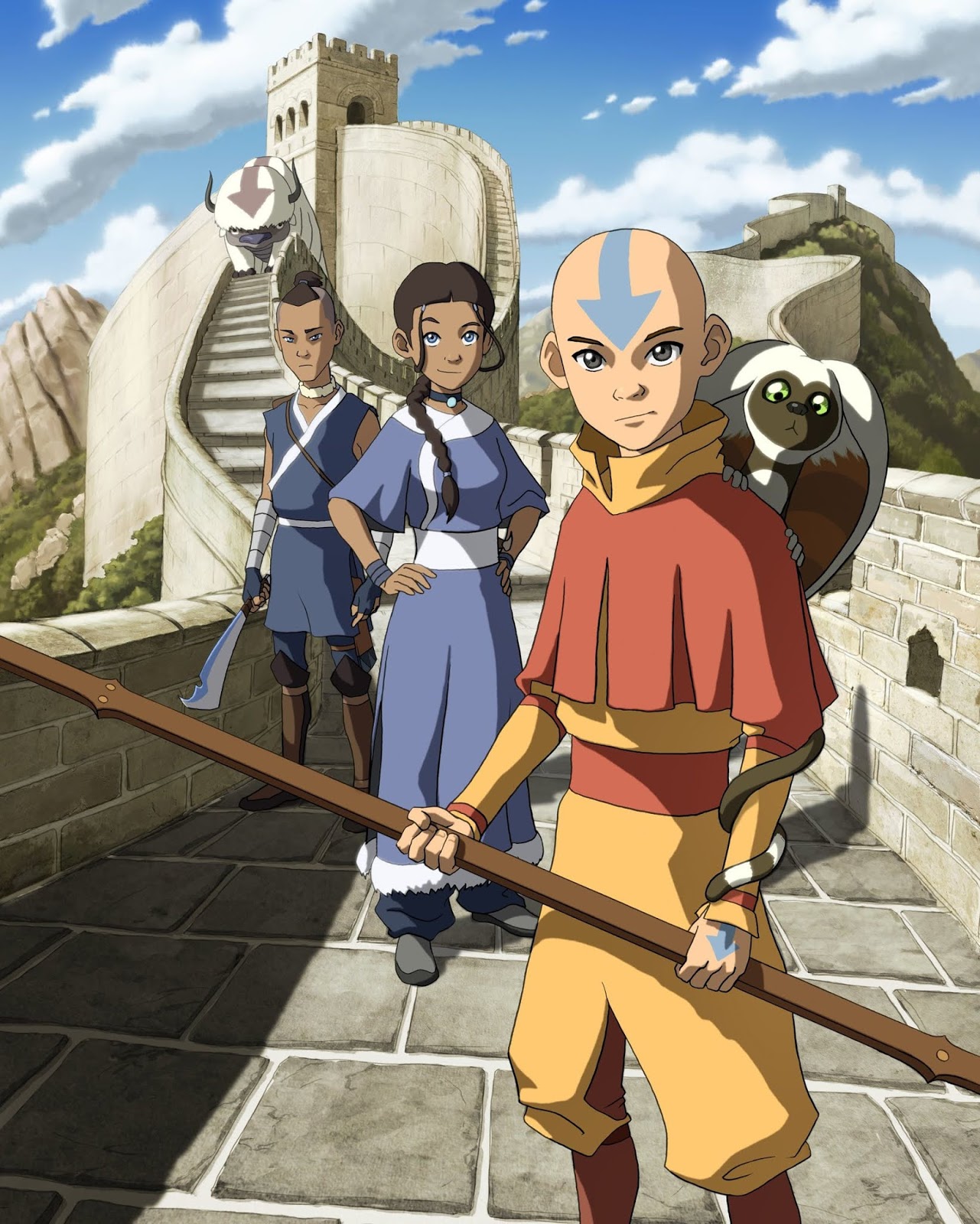
Aang, Katara and Sokka attempt to defeat the megalomaniacal fire lord.
But it’s the magical “bending,” so named to describe how its wielders manipulate, tease and strong-arm their element into submission, that is the most entrancing adaptation of Eastern cultural traditions. Each bending style is inspired by a classic Chinese martial art, which the show’s creators developed under the direction of a martial arts consultant. The flighty, variable and evasive air-bending of Aang resembles Baguazhang; the soft, fluid water-bending takes cues from tai chi; earth-bending, with its stability and immovable stances, is grounded in hung gar; and the fierce, aggressive fire-bending style is adapted from Northern Shaolin kung fu.
Aang is corrected by his masters as he learns: He must deepen his stance or turn his arm just so; he must clear his mind and direct the energy through him. Movement is key; the citizens of each nation move differently, so movement is linked to culture, a national disposition, a history within the narrative and a larger, real-life context, of the cultures and traditions that inform these fictional styles.
DiMartino and Konietzko’s admiration for Eastern culture surfaces throughout the series, a loving pastiche of allusions and inspirations: anime, Kung Fu flicks, world mythologies, Native tribes, Studio Ghibli films. In one episode, when Aang is plagued by a series of nightmares about his imminent face-off with the fire lord, the animation playfully morphs to mimic that of other famous anime series, like “Dragon Ball Z.”
“Avatar” managed to embrace all of the above while also conscientiously navigating the tricky minefield of cultural appropriation. The writers were mindful of any inadvertent links the show might make between one of the fictional nations and real Asian countries. Designs and artwork more explicitly based on those of actual countries were reworked so as to avoid any negative inferences that could come with the association. The show also brought in Edwin Zane, the former vice president of the Media Action Network for Asian-Americans, as a consultant to make sure questions of cultural sensitivity would be addressed.
After all, “Avatar” is unique in its approach to world-building. The show could have easily placed its world in proximity to whiteness by having the four nations be just one part of a larger landscape still occupied by white people, so that even if the story starred Asian characters, whiteness would still be a prominent feature. Instead, the show built a world with its own history and culture outside of that, where the characters seem, by default, Asian and view life through an Eastern lens rather than a white Western one.
The coronavirus, which first spread through China, has invited racist associations of Asianness with disease and spurred a surge in anti-Asian rhetoric and abuses. The pandemic has also exacerbated the divide between the white majority and the nonwhite minority: Already disadvantaged demographics have been hit especially hard by Covid-19 infections, job losses and business struggles, and, most troubling, harassment and death at the hands of the police. The so-called land of opportunity lately has become better known as a land of opportunities for hatred and violence. What “Avatar” provides is a world untethered from any definition or perspective that values whiteness above all else.
Despite its meticulous care and sensitivity, “Avatar” still bears Western characteristics. The animation, though inspired by Japanese anime (the creators cited the bewitchingly loony cult favorite “Fooly Cooly” in particular), with its exaggerated features, outsized reactions and dynamic action scenes, nevertheless sports the glossy American style of other Nickelodeon cartoons. (DiMartino and Konietzko originally aimed to do a coproduction with a Japanese studio but said that they found the studios unresponsive. They eventually teamed up with the small Korean studio Tin House for the pilot, and many of the studio’s artists continued working on the series throughout its run.)
Most egregious, the voice actors are mostly white, a glaring misstep for a production that was otherwise conscientious about cultural representation. (The limp 2010 live-action movie adaptation by M. Night Shyamalan was even more whitewashed, sparking a controversy over its casting.) The show’s dialogue is also rife with American idioms, and allusions to U.S. regionalism abound, as in one episode featuring a tribe of swamp-based water-benders who sound like they’ve been transplanted from the Deep South.
But whatever the instances of assimilation and translation, they never come across as a result of a Western superiority complex. Rather, as the United States continues to navigate a querulous relationship with China — not to mention a bloody history of war and forceful intervention with other countries in the East — and contend with its inequalities here, perhaps it’s more accurate to think of “Avatar” as delivering something that never sought to adapt or transcribe East to West, but respectfully marry and unify the two.
Its return to television offers a timely reminder: The story doesn’t always have to be of the same white America. There’s a whole wide world of narratives and traditions that resonate because of, not despite, the alternative view they present.
--Ends--
More Nick: Netflix to Host Open Casting Call for Live-Action 'Avatar: The Last Airbender' Series!
Follow NickALive! on Twitter, Tumblr, Reddit, via RSS, on Instagram, and/or Facebook for the latest Nickelodeon, NickRewind, Avatar: The Last Airbender and The Legend of Korra News and Highlights!
'Avatar: The Last Airbender' Is Currently the Most Popular Thing on Netflix
Fans of Avatar: The Last Airbender, of which there are many, have been waiting for Nickelodeon's acclaimed animated series to return to Netflix for some time, especially since it was revealed that the streaming service was working on a live-action adaptation of the property. That reality finally came to be last week, as all three seasons of Avatar began streaming on Netflix once again. Based on the conversation surrounding the show before its Netflix return, it should come as no surprise that people have flocking towards it.

Just a couple of days after arriving on Netflix, Avatar: The Last Airbender has become the most popular title on the entire service. This includes both movies and TV shows. On Tuesday's edition of the Netflix Top 10, Avatar appears at the very top of the list, beating out popular CW series and new Netflix originals.
The entire Avatar franchise has been a big hit on Netflix throughout 2020. M. Night Shyamalan's much maligned film adaptation, simply called The Last Airbender, debuted on the streaming service earlier this year. Despite its failure upon release 10 years ago, and it's continued bashing at the hands of both critics and fans, The Last Airbender was a staple of the Netflix Top 10 for weeks after its arrival.
Unlike the movie, the Avatar series still holds up for fans, and remains one of the most celebrated animated adventures of our time. It makes total sense that everyone is heading to Netflix to binge it all over again.
To hype Avatar: The Last Airbender returning to Netflix, Nickelodeon and Netflix turned to social media. Nickelodeon launched a dedicated Avatar: The Last Airbender YouTube channel, whilst Nick and Netflix partnered with Sprice Machines to create a domino tribute to the series.
Created by Michael DiMartino and Bryan Konietzko and airing between 2005 and 2008, the critically-acclaimed Avatar: The Last Airbender is set in world people can manipulate the elements of Earth, Water, Fire, and Air, and they lived peacefully in different regions until one of the nations started a world war. One master who can manipulate all four elements, dubbed the "Avatar," had been able to prevent this war, but disappeared soon after. 100 years later, a new Avatar named Aang awakens and sets out on a journey to master all the elements in order to bring peace to the land once more by defeating Fire Lord Ozai and ending the destructive war with the Fire Nation.
The series managed to be such a hit with fans by combining amazing animated action set pieces with three dimensional interesting characters set in this magical fantasy world.
The animated series originally aired for 61 episodes over three seasons ("Books") originally on Nickelodeon, where it began in February 2005 and concluded in July 2008. The series was nominated for—and won—Annie Awards, Genesis Awards, a Primetime Emmy Award, and a Peabody Award.
Its success led to the creation of adjacent consumer products, including video games, and a follow-up series, The Legend of Korra, that returned to the world of Avatar years after Aang’s death to follow Korra, his successor as Avatar. That series ran between 2012-2014. In 2010, the series got its first feature-length film, The Last Airbender.
The stories of both Avatar: The Last Airbender and The Legend of Korra have since continued on in graphic novel series.
Netflix will be putting out an Avatar: The Last Airbender live-action series from original creators DiMartino and Konietzko sometime in the future, with filming set to begin this year. The streaming giant has said that it plans to stay true to the location and “background heritage” of the animated series after the 2010 film failed to do so.
Paramount Home Entertainment and Nickelodeon Home Entertainment released the Avatar: The Last Airbender – The Complete Series 15th Anniversary Limited Edition Steelbook Collection in February 2020.
Original source: ComicBook.
From IndieWire:
Netflix Fights ‘Korra’ Backlash After ‘Avatar: The Last Airbender’ Begins Streaming
When all three seasons of "Avatar: The Last Airbender" debuted on Netflix this month, it reignited a heated debate among fans over the sequel series.
Fans of the Nickelodeon animated series “Avatar: The Last Airbender” rejoiced this month when all three seasons of the show made their Netflix debut May 15, but it didn’t take long for backlash to stir on social media. The Netflix debut of “Avatar” has reignited a heated debate among fans over the sequel series, “The Legend of Korra.” Backlash against “Korra” became so widespread on Twitter that Netflix got involved and defended the show through its @NXOnNetflix account, which is the streamer’s official “home of all things geek.”
The original “Avatar” series ran for three seasons between 2005 and 2008 and garnered widespread critical acclaim. The show won various industry prizes each season, including the Annie Award for Best Animated Television Production for Children with its third and final run of episodes. Four years after the series finale, creators Michael DiMartino and Bryan Konietzko revisited the franchise with the “Korra” sequel series. “Korra” ran for four seasons from 2012 to 2014 and was also a critical favorite, although the change in story direction irked some fans of the original series.
“Korra” is set 70 years after the events of “Avatar,” so the shows greatly differ in protagonists and settings. “Avatar” follows the adventures of a 12-year-old boy named Aang who is the last survivor of the Air Nomads. “Korra” picks up seven decades later to follow the adventures of Aang’s eponymous successor, a headstrong 17-year-old girl. That the “Avatar” creators decided not to continue Aang’s story in the sequel and instead chose to follow a new character has often been the center of fan backlash, as has “Korra’s” increased focus on inclusive storytelling. The “Korra” finale is infamous for the controversy it earned over the romantic pairing of Korra and Asami, two women of color. Den of Geek writer Michael Mammano did an excellent job in 2014 analyzing the homophobic undertones present within the “Korra” backlash.
As mentioned above, “Korra” backlash started ramping up on social media in the aftermath of “Avatar’s” Netflix debut, so much so that new essays were published over the last week defending “Korra” and urging viewers to give it a second chance. Netflix first got involved in the social media debate by responding to one fan who posted artwork of the original “Avatar” characters grown up. The fan caption read: “Imagine an alternate universe where four seasons of this dropped instead of ‘Korra.’ Yeah, I’d wanna live there.” The post leaned into backlash claiming the sequel series should’ve continued Aang’s story and not focused on a new character.
Netflix issued a response to the fan, writing: “Korra’s story was important. Aang’s story had been told.” The reply has generated over 45,000 likes and counting. The streamer didn’t stop there and continued to respond to fans expressing negative opinions about “Korra.” Netflix told one fan, “Both [series] were important and essential to the ‘Avatar’ universe. No two avatars have the same perspective or growth.”
One “Avatar” fan mentioned that Netflix is developing a live-action “Avatar” series, implying that’s proof the streamer values the original series more than it does “Korra.” Netflix shut the assumption down by responding, “Korra’s story being important doesn’t mean that Aang’s isn’t.”
Netflix announced in September 2018 it’s producing a live-action “Avatar” series with original creators DiMartino and Konietzko serving as showrunners and executive producers.
“We can’t wait to realize Aang’s world as cinematically as we always imagined it to be, and with a culturally appropriate, non-whitewashed cast,” the creators said in a statement at the time — M. Night Shyamalan’s 2010 film adaptation had been whitewashed. “It’s a once-in-a-lifetime chance to build upon everyone’s great work on the original animated series and go even deeper into the characters, story, action, and world-building. Netflix is wholly dedicated to manifesting our vision for this retelling, and we’re incredibly grateful to be partnering with them.”
Netflix has not announced a release date for its live-action “Avatar” series, but all three seasons of the original animated series are now streaming.
###
From Forbes:
‘Avatar: The Last Airbender,’ A 15 Year-Old Cartoon, Is Now Netflix’s Most Popular Show

Netflix did not seem to be celebrating the arrival of Avatar: The Last Airbender with all that much fanfare when it arrived on the service this past weekend. Despite it being one of my favorite shows of all time, it was not recommended to me on my homepage, and did not show up in trending or new releases. Though when I went to manually search for it, there it was, under “most popular searches.”
And it seems I’m not alone.
As it stands right now, Avatar: The Last Airbender is the most popular series on Netflix in the US, beating out the likes of Riverdale, Dead to Me and Outer Banks, all huge series on the service. A new show appearing in the Most Popular Top 10 list is not all that unusual, and yet this is not a new show, this is a 15 year-old Nickelodeon cartoon that is so ancient it’s still in the 4:3 ratio format instead of widescreen.
I have already extolled the virtues of this series in other articles, but the point is that no one should be turned off by the fact that it’s A) old, B) animated or C) on Nickelodeon originally which implies it’s for kids. It isn’t (though yes, your kids can watch it), and is a great series that blends elements of fantasy and the superhero genre for one of the best-told stories in TV history.
As of right now, Netflix does not have the sequel series, The Legend of Korra, which I believe is on CBS All Access right now. However, a while ago it was announced that Netflix would be making a live-action adaptation of the original show with the founding creators returning for it. This would of course be the second attempt at a live action adaptation of the series, as M. Night Shyamalan famously made a blockbuster film version that was universally derided as horrific, and most Avatar fans have attempted to scrub it from their memories.
Avatar showing up as number one on the service right now is indicative of a lot of people like me rewatching it (I think the last time I saw this show in its entirety, I had downloaded it through Pirate Bay torrents), or it could be newcomers discovering it for the first time. Whatever the case, Netflix is likely feeling pretty comfortable with their decision to draw upon the series for a live-action version, though obviously plenty could go wrong if it’s not handled correctly.
As I’ve said before, I cannot recommend the series enough. It’s around 60, 20 minute episodes in total, and a breeze to get through. I watched ten in a row yesterday without even blinking. It’s a fantastic series everyone should experience, and don’t let it being old or animated chase you away. Give it a shot.
###
From Vulture:
Avatar: The Last Airbender premiered on Nickelodeon just as George W. Bush was starting his second term and ended its run before Barack Obama was elected president. It’s also shaping up to be one of this summer’s breakout Netflix hits.
While quantifying success for streaming shows isn’t an exact science due to the lack of an industry-ratings standing for the medium, the publicly available data that does exist suggests The Last Airbender is doing spectacularly well. The animated series, which tells the story of a boy fated to restore balance to his war-torn world, arrived on Netflix on May 15 and almost immediately seemed to catch the attention of American audiences:
• The Last Airbender landed on Netflix’s daily top-ten series list within a day of its debut, climbing to the No. 1 spot in the U.S. on May 19 and ranking as the most popular TV show or movie on the service for the full week of May 14-21.
• It slipped from the top spot by May 24, but it’s been among the top ten shows on the service ever since. That’s more than a month, outlasting other high-profile hits released around the same time, including season four of Queer Eye, The Unbreakable Kimmy Schmidt interactive movie, and new original drama Sweet Magnolias.
• Research firm Parrot Analytics — which tracks interest in TV shows as measured by search engines, critic and fan ratings sites, blogs, and social media, among other sources — says The Last Airbender has exploded in popularity since entering the Netflix library. It says U.S. audience demand for the show jumped 206 percent last month vs. May 2019, and has ranked the show among the ten biggest TV shows on any U.S. platform in its two most recent demand reports. Indeed, Parrot says interest in the show has grown over its five-week run on Netflix: During the week of June 7-13, The Last Airbender was 71.2 times more in demand than the typical U.S. TV title, up from 59.8 times more popular two weeks sooner.
• And in a related sign of how popular the Avatar: The Last Airbender franchise remains, sequel series The Legend of Korra (which ran on Nick from 2012 until 2014) has been a big hit for rival streamer CBS All Access. A rep for the platform says the show has been the No. 1 kids title on the service since the show premiered in January.
The usual caveats to all of the above apply: Netflix’s self-reported popularity rankings aren’t comparable to Nielsen ratings, both because they’re not independently verified and because they don’t measure average audience for a show. (Netflix ranks shows according to how many people select a title and then spend at least two minutes watching it, which is a fair gauge of how much interest there is in a show but doesn’t measure overall time spent watching a show or whether members who check out a show or movie stick with it til the end.) And because streamers don’t generally report specific average audience numbers, there’s no way of knowing for sure whether 25 million or 2.5 million Americans have binged The Last Airbender in the past month.
Still, the fact that reruns of a 15-year-old animated series are doing so well is pretty incredible, particularly given the lack of any major coordinated marketing push for the show. This speaks to something Netflix execs have long pointed to as a key strength of the platform: The ability to use the vaunted algorithm to connect subscribers to the right content. There’s no need to spend $20 million on TV ads for a library title like The Last Airbender when Netflix can simply put the title on the homepage for millions of members whose past viewing habits indicate they’d be into it.
And the fact that Parrot’s data suggests interest in The Last Airbender has grown over time may be a sign of just how smart it was for Netflix to begin showing members a content row listing the top 10 titles on the service for any given day. Tell people that other people are into something, and a significant number of folks are going to want to see what all the fuss is about. And yes, those of us in the media who write about Netflix’s top-ten lists are part of the platform’s marketing ecosystem.
There’s another reason the seeming success of The Last Airbender is good news for the platform: A live-action series adaptation has been in the works at the streamer since 2018, with original creators Michael DiMartino and Bryan Konietzko supervising production. Though no doubt many of the people watching the animated series on Netflix now are likely millennials reliving their youth and catching up on what’s become a beloved classic, the continuing success of the show these past five weeks hints at the possibility of new fans being created. In essence, these reruns are serving as a very effective marketing campaign for the coming live-action series (as well as a palate cleanser for any damage done to the franchise by 2010’s live-action feature-film adaptation, a critical and box-office disaster overseen by director M. Night Shyamalan).
So what’s the status of the new Airbender series? Reps for Netflix and Nickelodeon both declined comment on where things stand with the project, though sources confirm it’s still in development at the platform. Still, there are signs things are progressing — though fans hoping to stream the series this year will almost certainly disappointed.
Konietzko’s Instagram, and at the time, he said plans to begin casting via an open casting call sometime in 2019 were still on hold. “Obviously we have not reached that stage yet or else you would have heard about it from me, Netflix, etc.,” he wrote. “We’re working on some awesome stuff, but we’re still in development/pre production.” Noting that the coronavirus pandemic had brought global TV production to a halt, he indicated remote work on the project was continuing. “At the moment, we are lucky that our small team on the adaptation is still moving things forward as best we can, obviously all working remotely,” Konietzko explained, promising that when there is “news we *can* share, we will share it … Just be patient.”
Without knowing how far along in the script process the show’s writers are, it’s hard to know when the live-action The Last Airbender series might land on screens. Even if all episodes have been written, if casting hasn’t started, that process could take several months once coronavirus restrictions ease to the point that casting calls could take place. (An open call with thousands of actors seems unlikely anytime soon, though producers could change course and opt for a more limited casting process.) It’s likely Netflix’s adaptation of The Last Airbender will be relatively epic in scope, too, something which would require a longer shoot and extensive special-effects work. So unless Netflix and the show’s producers have been operating under extreme secrecy, and a cast is actually quietly waiting to start filming, it’s hard to see the live-action Avatar: The Last Airbender debuting any earlier than late 2021.
Given how popular the reruns are doing right now, Netflix execs probably wouldn’t have minded having the new live action series premiere much earlier, ideally sometime later this year. But maybe there’s an upside to waiting: Netflix has even more time to recruit new audiences (young and old) into the Avatar: The Last Airbender universe.
###
More Nick: Netflix to Host Open Casting Call for Live-Action 'Avatar: The Last Airbender' Series!
Originally published: Wednesday, May 20, 2020 at 01:27 BST.
Follow NickALive! on Twitter, Tumblr, Reddit, via RSS, on Instagram, and/or Facebook for the latest Nickelodeon, NickRewind, Avatar: The Last Airbender and The Legend of Korra News and Highlights!

Just a couple of days after arriving on Netflix, Avatar: The Last Airbender has become the most popular title on the entire service. This includes both movies and TV shows. On Tuesday's edition of the Netflix Top 10, Avatar appears at the very top of the list, beating out popular CW series and new Netflix originals.
The entire Avatar franchise has been a big hit on Netflix throughout 2020. M. Night Shyamalan's much maligned film adaptation, simply called The Last Airbender, debuted on the streaming service earlier this year. Despite its failure upon release 10 years ago, and it's continued bashing at the hands of both critics and fans, The Last Airbender was a staple of the Netflix Top 10 for weeks after its arrival.
Unlike the movie, the Avatar series still holds up for fans, and remains one of the most celebrated animated adventures of our time. It makes total sense that everyone is heading to Netflix to binge it all over again.
To hype Avatar: The Last Airbender returning to Netflix, Nickelodeon and Netflix turned to social media. Nickelodeon launched a dedicated Avatar: The Last Airbender YouTube channel, whilst Nick and Netflix partnered with Sprice Machines to create a domino tribute to the series.
Created by Michael DiMartino and Bryan Konietzko and airing between 2005 and 2008, the critically-acclaimed Avatar: The Last Airbender is set in world people can manipulate the elements of Earth, Water, Fire, and Air, and they lived peacefully in different regions until one of the nations started a world war. One master who can manipulate all four elements, dubbed the "Avatar," had been able to prevent this war, but disappeared soon after. 100 years later, a new Avatar named Aang awakens and sets out on a journey to master all the elements in order to bring peace to the land once more by defeating Fire Lord Ozai and ending the destructive war with the Fire Nation.
The series managed to be such a hit with fans by combining amazing animated action set pieces with three dimensional interesting characters set in this magical fantasy world.
The animated series originally aired for 61 episodes over three seasons ("Books") originally on Nickelodeon, where it began in February 2005 and concluded in July 2008. The series was nominated for—and won—Annie Awards, Genesis Awards, a Primetime Emmy Award, and a Peabody Award.
Its success led to the creation of adjacent consumer products, including video games, and a follow-up series, The Legend of Korra, that returned to the world of Avatar years after Aang’s death to follow Korra, his successor as Avatar. That series ran between 2012-2014. In 2010, the series got its first feature-length film, The Last Airbender.
The stories of both Avatar: The Last Airbender and The Legend of Korra have since continued on in graphic novel series.
Netflix will be putting out an Avatar: The Last Airbender live-action series from original creators DiMartino and Konietzko sometime in the future, with filming set to begin this year. The streaming giant has said that it plans to stay true to the location and “background heritage” of the animated series after the 2010 film failed to do so.
Paramount Home Entertainment and Nickelodeon Home Entertainment released the Avatar: The Last Airbender – The Complete Series 15th Anniversary Limited Edition Steelbook Collection in February 2020.
Original source: ComicBook.
From IndieWire:
Netflix Fights ‘Korra’ Backlash After ‘Avatar: The Last Airbender’ Begins Streaming
When all three seasons of "Avatar: The Last Airbender" debuted on Netflix this month, it reignited a heated debate among fans over the sequel series.
Fans of the Nickelodeon animated series “Avatar: The Last Airbender” rejoiced this month when all three seasons of the show made their Netflix debut May 15, but it didn’t take long for backlash to stir on social media. The Netflix debut of “Avatar” has reignited a heated debate among fans over the sequel series, “The Legend of Korra.” Backlash against “Korra” became so widespread on Twitter that Netflix got involved and defended the show through its @NXOnNetflix account, which is the streamer’s official “home of all things geek.”
The original “Avatar” series ran for three seasons between 2005 and 2008 and garnered widespread critical acclaim. The show won various industry prizes each season, including the Annie Award for Best Animated Television Production for Children with its third and final run of episodes. Four years after the series finale, creators Michael DiMartino and Bryan Konietzko revisited the franchise with the “Korra” sequel series. “Korra” ran for four seasons from 2012 to 2014 and was also a critical favorite, although the change in story direction irked some fans of the original series.
“Korra” is set 70 years after the events of “Avatar,” so the shows greatly differ in protagonists and settings. “Avatar” follows the adventures of a 12-year-old boy named Aang who is the last survivor of the Air Nomads. “Korra” picks up seven decades later to follow the adventures of Aang’s eponymous successor, a headstrong 17-year-old girl. That the “Avatar” creators decided not to continue Aang’s story in the sequel and instead chose to follow a new character has often been the center of fan backlash, as has “Korra’s” increased focus on inclusive storytelling. The “Korra” finale is infamous for the controversy it earned over the romantic pairing of Korra and Asami, two women of color. Den of Geek writer Michael Mammano did an excellent job in 2014 analyzing the homophobic undertones present within the “Korra” backlash.
As mentioned above, “Korra” backlash started ramping up on social media in the aftermath of “Avatar’s” Netflix debut, so much so that new essays were published over the last week defending “Korra” and urging viewers to give it a second chance. Netflix first got involved in the social media debate by responding to one fan who posted artwork of the original “Avatar” characters grown up. The fan caption read: “Imagine an alternate universe where four seasons of this dropped instead of ‘Korra.’ Yeah, I’d wanna live there.” The post leaned into backlash claiming the sequel series should’ve continued Aang’s story and not focused on a new character.
Netflix issued a response to the fan, writing: “Korra’s story was important. Aang’s story had been told.” The reply has generated over 45,000 likes and counting. The streamer didn’t stop there and continued to respond to fans expressing negative opinions about “Korra.” Netflix told one fan, “Both [series] were important and essential to the ‘Avatar’ universe. No two avatars have the same perspective or growth.”
One “Avatar” fan mentioned that Netflix is developing a live-action “Avatar” series, implying that’s proof the streamer values the original series more than it does “Korra.” Netflix shut the assumption down by responding, “Korra’s story being important doesn’t mean that Aang’s isn’t.”
Netflix announced in September 2018 it’s producing a live-action “Avatar” series with original creators DiMartino and Konietzko serving as showrunners and executive producers.
“We can’t wait to realize Aang’s world as cinematically as we always imagined it to be, and with a culturally appropriate, non-whitewashed cast,” the creators said in a statement at the time — M. Night Shyamalan’s 2010 film adaptation had been whitewashed. “It’s a once-in-a-lifetime chance to build upon everyone’s great work on the original animated series and go even deeper into the characters, story, action, and world-building. Netflix is wholly dedicated to manifesting our vision for this retelling, and we’re incredibly grateful to be partnering with them.”
Netflix has not announced a release date for its live-action “Avatar” series, but all three seasons of the original animated series are now streaming.
Korra’s👏story👏was👏important👏
— NX (@NXOnNetflix) May 19, 2020
Aang’s👏story👏had👏been👏told👏 https://t.co/2rpIuQR7q1
both were important and essential to the avatar universe. no two avatars have the same perspective or growth
— NX (@NXOnNetflix) May 19, 2020
Korra’s story being important doesn’t mean that Aang’s isn't.
— NX (@NXOnNetflix) May 19, 2020
KORRA'S STORY WAS IMPORTANT
— NX (@NXOnNetflix) May 19, 2020
###
From Forbes:
‘Avatar: The Last Airbender,’ A 15 Year-Old Cartoon, Is Now Netflix’s Most Popular Show

Netflix did not seem to be celebrating the arrival of Avatar: The Last Airbender with all that much fanfare when it arrived on the service this past weekend. Despite it being one of my favorite shows of all time, it was not recommended to me on my homepage, and did not show up in trending or new releases. Though when I went to manually search for it, there it was, under “most popular searches.”
And it seems I’m not alone.
As it stands right now, Avatar: The Last Airbender is the most popular series on Netflix in the US, beating out the likes of Riverdale, Dead to Me and Outer Banks, all huge series on the service. A new show appearing in the Most Popular Top 10 list is not all that unusual, and yet this is not a new show, this is a 15 year-old Nickelodeon cartoon that is so ancient it’s still in the 4:3 ratio format instead of widescreen.
I have already extolled the virtues of this series in other articles, but the point is that no one should be turned off by the fact that it’s A) old, B) animated or C) on Nickelodeon originally which implies it’s for kids. It isn’t (though yes, your kids can watch it), and is a great series that blends elements of fantasy and the superhero genre for one of the best-told stories in TV history.
As of right now, Netflix does not have the sequel series, The Legend of Korra, which I believe is on CBS All Access right now. However, a while ago it was announced that Netflix would be making a live-action adaptation of the original show with the founding creators returning for it. This would of course be the second attempt at a live action adaptation of the series, as M. Night Shyamalan famously made a blockbuster film version that was universally derided as horrific, and most Avatar fans have attempted to scrub it from their memories.
Avatar showing up as number one on the service right now is indicative of a lot of people like me rewatching it (I think the last time I saw this show in its entirety, I had downloaded it through Pirate Bay torrents), or it could be newcomers discovering it for the first time. Whatever the case, Netflix is likely feeling pretty comfortable with their decision to draw upon the series for a live-action version, though obviously plenty could go wrong if it’s not handled correctly.
As I’ve said before, I cannot recommend the series enough. It’s around 60, 20 minute episodes in total, and a breeze to get through. I watched ten in a row yesterday without even blinking. It’s a fantastic series everyone should experience, and don’t let it being old or animated chase you away. Give it a shot.
###
From Vulture:
Avatar: The Last Airbender premiered on Nickelodeon just as George W. Bush was starting his second term and ended its run before Barack Obama was elected president. It’s also shaping up to be one of this summer’s breakout Netflix hits.
While quantifying success for streaming shows isn’t an exact science due to the lack of an industry-ratings standing for the medium, the publicly available data that does exist suggests The Last Airbender is doing spectacularly well. The animated series, which tells the story of a boy fated to restore balance to his war-torn world, arrived on Netflix on May 15 and almost immediately seemed to catch the attention of American audiences:
• The Last Airbender landed on Netflix’s daily top-ten series list within a day of its debut, climbing to the No. 1 spot in the U.S. on May 19 and ranking as the most popular TV show or movie on the service for the full week of May 14-21.
• It slipped from the top spot by May 24, but it’s been among the top ten shows on the service ever since. That’s more than a month, outlasting other high-profile hits released around the same time, including season four of Queer Eye, The Unbreakable Kimmy Schmidt interactive movie, and new original drama Sweet Magnolias.
• Research firm Parrot Analytics — which tracks interest in TV shows as measured by search engines, critic and fan ratings sites, blogs, and social media, among other sources — says The Last Airbender has exploded in popularity since entering the Netflix library. It says U.S. audience demand for the show jumped 206 percent last month vs. May 2019, and has ranked the show among the ten biggest TV shows on any U.S. platform in its two most recent demand reports. Indeed, Parrot says interest in the show has grown over its five-week run on Netflix: During the week of June 7-13, The Last Airbender was 71.2 times more in demand than the typical U.S. TV title, up from 59.8 times more popular two weeks sooner.
• And in a related sign of how popular the Avatar: The Last Airbender franchise remains, sequel series The Legend of Korra (which ran on Nick from 2012 until 2014) has been a big hit for rival streamer CBS All Access. A rep for the platform says the show has been the No. 1 kids title on the service since the show premiered in January.
The usual caveats to all of the above apply: Netflix’s self-reported popularity rankings aren’t comparable to Nielsen ratings, both because they’re not independently verified and because they don’t measure average audience for a show. (Netflix ranks shows according to how many people select a title and then spend at least two minutes watching it, which is a fair gauge of how much interest there is in a show but doesn’t measure overall time spent watching a show or whether members who check out a show or movie stick with it til the end.) And because streamers don’t generally report specific average audience numbers, there’s no way of knowing for sure whether 25 million or 2.5 million Americans have binged The Last Airbender in the past month.
Still, the fact that reruns of a 15-year-old animated series are doing so well is pretty incredible, particularly given the lack of any major coordinated marketing push for the show. This speaks to something Netflix execs have long pointed to as a key strength of the platform: The ability to use the vaunted algorithm to connect subscribers to the right content. There’s no need to spend $20 million on TV ads for a library title like The Last Airbender when Netflix can simply put the title on the homepage for millions of members whose past viewing habits indicate they’d be into it.
And the fact that Parrot’s data suggests interest in The Last Airbender has grown over time may be a sign of just how smart it was for Netflix to begin showing members a content row listing the top 10 titles on the service for any given day. Tell people that other people are into something, and a significant number of folks are going to want to see what all the fuss is about. And yes, those of us in the media who write about Netflix’s top-ten lists are part of the platform’s marketing ecosystem.
There’s another reason the seeming success of The Last Airbender is good news for the platform: A live-action series adaptation has been in the works at the streamer since 2018, with original creators Michael DiMartino and Bryan Konietzko supervising production. Though no doubt many of the people watching the animated series on Netflix now are likely millennials reliving their youth and catching up on what’s become a beloved classic, the continuing success of the show these past five weeks hints at the possibility of new fans being created. In essence, these reruns are serving as a very effective marketing campaign for the coming live-action series (as well as a palate cleanser for any damage done to the franchise by 2010’s live-action feature-film adaptation, a critical and box-office disaster overseen by director M. Night Shyamalan).
So what’s the status of the new Airbender series? Reps for Netflix and Nickelodeon both declined comment on where things stand with the project, though sources confirm it’s still in development at the platform. Still, there are signs things are progressing — though fans hoping to stream the series this year will almost certainly disappointed.
Konietzko’s Instagram, and at the time, he said plans to begin casting via an open casting call sometime in 2019 were still on hold. “Obviously we have not reached that stage yet or else you would have heard about it from me, Netflix, etc.,” he wrote. “We’re working on some awesome stuff, but we’re still in development/pre production.” Noting that the coronavirus pandemic had brought global TV production to a halt, he indicated remote work on the project was continuing. “At the moment, we are lucky that our small team on the adaptation is still moving things forward as best we can, obviously all working remotely,” Konietzko explained, promising that when there is “news we *can* share, we will share it … Just be patient.”
Without knowing how far along in the script process the show’s writers are, it’s hard to know when the live-action The Last Airbender series might land on screens. Even if all episodes have been written, if casting hasn’t started, that process could take several months once coronavirus restrictions ease to the point that casting calls could take place. (An open call with thousands of actors seems unlikely anytime soon, though producers could change course and opt for a more limited casting process.) It’s likely Netflix’s adaptation of The Last Airbender will be relatively epic in scope, too, something which would require a longer shoot and extensive special-effects work. So unless Netflix and the show’s producers have been operating under extreme secrecy, and a cast is actually quietly waiting to start filming, it’s hard to see the live-action Avatar: The Last Airbender debuting any earlier than late 2021.
Given how popular the reruns are doing right now, Netflix execs probably wouldn’t have minded having the new live action series premiere much earlier, ideally sometime later this year. But maybe there’s an upside to waiting: Netflix has even more time to recruit new audiences (young and old) into the Avatar: The Last Airbender universe.
###
More Nick: Netflix to Host Open Casting Call for Live-Action 'Avatar: The Last Airbender' Series!
Originally published: Wednesday, May 20, 2020 at 01:27 BST.
Follow NickALive! on Twitter, Tumblr, Reddit, via RSS, on Instagram, and/or Facebook for the latest Nickelodeon, NickRewind, Avatar: The Last Airbender and The Legend of Korra News and Highlights!
#NickSaysDance | Ft. Aadil Khan | Motu Patlu Ki Jodi | Nickelodeon India
#NickSaysDance | Ft. Aadil Khan | Motu Patlu Ki Jodi | Nickelodeon India
All set to Learn, Dance, Create, Repeat? #NickSaysDance
Aadil Khan is here to set the floor on fire with his super cool moves.
Check out the video now!
#Motu #Patlu #MotuPatlu #MotuPatluKiJodi #Aadil #Dancing #NickDanceSquad
Nickelodeon and Nick HD+ have launched new campaigns – ‘Nick Says Dance’ and ‘Loud Your Family Photo Competition’.
With Nickelodeon celebrating the 100th episode of comedy animated series, The Loud House very recently, the channel has initiated a Photo Competition, wherein kids can send their wackiest family photo and stand in a chance to win a hand painted cartoon portrait of it, besides being featured on TV.
On the other hand, ‘Nick Says Dance’ features social media star, Aadil Khan who’d make kids learn fun dance moves. The videos will help kids engaged during this lengthy summer holidays. The dance video also features Motu and Patlu and is available on Nick India’s officical Instagram page.
Both this campaigns come under Nickelodeon’s #HomeOkPlease initiative by bringing the playground home through engaging tentpoles on air, new episodes and made for television movies, celebrating special occasions and innovative DIY campaigns on social and digital platforms.
Earlier, commenting on #HomeOkPlease, Viacom18 Hindi Mass Entertainment and Kids TV Network head Nina Elavia Jaipuria said, “As a leading and responsible kids entertainment brand and category leader our primary objective is to ensure that kids who are at the centre of all our initiatives remain engaged and positive in current times. It is important that their spirits are kept high and we have curated an array of best of entertainment and engagement that is sure to keep them happy and motivated. We hope that this summer, kids and families together have a great time with Nickelodeon in the safety of their homes.”
###
From Tellychakkar.com:
Yoga Se Hi Hoga teaches kids to build stronger immunity

MUMBAI: Practicing Yoga amongst kids is as important as it is for adults. It enhances their immune system, sharpen their minds and also encourages their creativity to flow. It helps them overcome their fears, anger, and sadness and builds trust in their inner self; syncing their minds and hearts. Now with Unlock 1.0 where the kids are still restricted from any form of outdoor activities and are also struggling between their online classes, Nickelodeon takes the onus in urging kids to include Yoga into their daily life with their fun and educative campaign. Under the campaign name – Yoga Se Hi Hoga, the brand sets out in spreading the awareness about how it’s important to have a healthy lifestyle and a stronger immune system.
Yoga also helps in better body awareness, self-control, flexibility and coordination. The advantages of yoga are many, especially for children with hyperactive and attention deficit disorder. Music therapy combined with asanas is a good relaxation for the child. Let’s have a look at 5 easy Yoga poses which can be performed by kids.
NATARAJASANA
Practicing this asana gives strength to your chest, ankles, hips, and legs. Natarajasana increases your metabolism and helps in weight loss and digestion.
PADMASANA
Padmasana stretches the ankles and knees and also calms the brain. It keeps the spine straight and helps develop a good posture. It also eases menstrual discomfort and sciatica
PINCHA MAYURASANA
Pincha Mayurasana makes the back, shoulders, and arms strong. It gives the neck, shoulders, chest, and belly a good stretch. It improves balance and concentration.
DHANURASANA
Dhanurasana gives maximum stretch on the abdomen and abdominal sides. Regular practice of this asana helps to shed and burn fat of various regions of the body. It also helps you tone your overall body shape
VRKSASANA
Vrksasana improves balance and stability in the legs. It helps in achieving a balance in other aspects of life.
###
More Nick: Nickelodeon India Brings the Playground Home for Kids with #HomeOkPlease Campaign!
Source: Animationxpress.
Originally published: Thursday, June 11, 2020.
Follow NickALive! on Twitter, Tumblr, Reddit, via RSS, on Instagram, and/or Facebook for the latest Nickelodeon India and The Loud House News and Highlights!
All set to Learn, Dance, Create, Repeat? #NickSaysDance
Aadil Khan is here to set the floor on fire with his super cool moves.
Check out the video now!
#Motu #Patlu #MotuPatlu #MotuPatluKiJodi #Aadil #Dancing #NickDanceSquad
Nickelodeon and Nick HD+ have launched new campaigns – ‘Nick Says Dance’ and ‘Loud Your Family Photo Competition’.
With Nickelodeon celebrating the 100th episode of comedy animated series, The Loud House very recently, the channel has initiated a Photo Competition, wherein kids can send their wackiest family photo and stand in a chance to win a hand painted cartoon portrait of it, besides being featured on TV.
On the other hand, ‘Nick Says Dance’ features social media star, Aadil Khan who’d make kids learn fun dance moves. The videos will help kids engaged during this lengthy summer holidays. The dance video also features Motu and Patlu and is available on Nick India’s officical Instagram page.
Both this campaigns come under Nickelodeon’s #HomeOkPlease initiative by bringing the playground home through engaging tentpoles on air, new episodes and made for television movies, celebrating special occasions and innovative DIY campaigns on social and digital platforms.
Earlier, commenting on #HomeOkPlease, Viacom18 Hindi Mass Entertainment and Kids TV Network head Nina Elavia Jaipuria said, “As a leading and responsible kids entertainment brand and category leader our primary objective is to ensure that kids who are at the centre of all our initiatives remain engaged and positive in current times. It is important that their spirits are kept high and we have curated an array of best of entertainment and engagement that is sure to keep them happy and motivated. We hope that this summer, kids and families together have a great time with Nickelodeon in the safety of their homes.”
###
From Tellychakkar.com:
Yoga Se Hi Hoga teaches kids to build stronger immunity

MUMBAI: Practicing Yoga amongst kids is as important as it is for adults. It enhances their immune system, sharpen their minds and also encourages their creativity to flow. It helps them overcome their fears, anger, and sadness and builds trust in their inner self; syncing their minds and hearts. Now with Unlock 1.0 where the kids are still restricted from any form of outdoor activities and are also struggling between their online classes, Nickelodeon takes the onus in urging kids to include Yoga into their daily life with their fun and educative campaign. Under the campaign name – Yoga Se Hi Hoga, the brand sets out in spreading the awareness about how it’s important to have a healthy lifestyle and a stronger immune system.
Yoga also helps in better body awareness, self-control, flexibility and coordination. The advantages of yoga are many, especially for children with hyperactive and attention deficit disorder. Music therapy combined with asanas is a good relaxation for the child. Let’s have a look at 5 easy Yoga poses which can be performed by kids.
NATARAJASANA
Practicing this asana gives strength to your chest, ankles, hips, and legs. Natarajasana increases your metabolism and helps in weight loss and digestion.
PADMASANA
Padmasana stretches the ankles and knees and also calms the brain. It keeps the spine straight and helps develop a good posture. It also eases menstrual discomfort and sciatica
PINCHA MAYURASANA
Pincha Mayurasana makes the back, shoulders, and arms strong. It gives the neck, shoulders, chest, and belly a good stretch. It improves balance and concentration.
DHANURASANA
Dhanurasana gives maximum stretch on the abdomen and abdominal sides. Regular practice of this asana helps to shed and burn fat of various regions of the body. It also helps you tone your overall body shape
VRKSASANA
Vrksasana improves balance and stability in the legs. It helps in achieving a balance in other aspects of life.
###
More Nick: Nickelodeon India Brings the Playground Home for Kids with #HomeOkPlease Campaign!
Source: Animationxpress.
Originally published: Thursday, June 11, 2020.
Follow NickALive! on Twitter, Tumblr, Reddit, via RSS, on Instagram, and/or Facebook for the latest Nickelodeon India and The Loud House News and Highlights!
Subscribe to:
Posts (Atom)